
Violins
While there are many different instruments they all include one thing: strings. My favorite one is a violin and I learned to play it when I was 8. Violins are high pitched and small instruments, they are the smallest in the string family, with the smallest being a 1/64 size. The world smallest playable violin measures about 1.6 inches (4.1 centimeters) and most children can play it when they are 2 and 3.
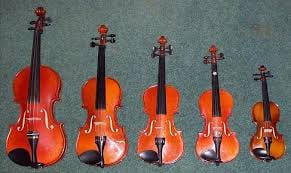
From my experience the violin has been easy to play. My school got me started since they had a strings program and I joined. Since then i have gotten much better and can sight read most pieces of music, sight reading is when you look at the notes for the first time with no fingerings written under them and play through it.
Violas


Viola’s are the second highest pitched instrument with the first being the violin. They are slightly bigger than a violin by about 3 inches. Their strings are A, C, G, and E, their E is the highest and their G is the lowest. Most viola players are in the middle of the stage right beside violins on the right and cellos on the left. Viola’s are also commonly in melodies of songs blending with the violin section and mostly on their highest string to match the pitch of violins. However, when the viola’s want to match the Cellos they go on their second lowest string, and even on the lowest string. Viola’s are also very popular, but lesser known than violins. We are also the most compatible to violins, but are very different. most violins are higher pitch, and viola’s are a medium pitch compared to cellos and bass’s. Viola’s are like the middle of the orchestra and they are a perfect pitch between high and low. So basically the viola’s are the most compatible to violins but could play some lower string violin parts, or some higher Cello parts if the viola’s pitch was relatively the same.
Cello’s


cellos are a lower stringed instrument, they compare very well to bass’s and similar to the viola, They can play two different parts. Cellos or a large kind of instrument they Have a lot of different sizes depending on your height normally you have to reach up a bit to play the fingerings. Cellos almost never get the melody and almost always play in unison to viola’s or bass’s, making them the perfect choice if you want to hold a steady rhythm and move your fingers a lot. They have to go into different positions to get to the different fingerings and have to go between fingerings quickly, making them a bit more complex them viola’s or bass’s.
Bass’s


bass’s are the lowest pitch instrument in orchestra’s. They are normally the beat of the orchestra, while others get the melody and some get the supporting parts, they keep a steady rhythm and guide the orchestra basically being a second conductor. The bass is the most unpopular instrument in the orchestra due to its size and lack of melodies., yet it is a key factor In the orchestra. Without the bass the orchestra would practically fall apart without the deep rhythm enhancing it spectacularly. The bass is essentially superglue holding the whole orchestra together. It brings a deep, rich, beautiful, and powerful essence to the orchestra. It’s also used in many famous songs and songwriters. The bass’s also are very large and heavy which is part of the reason it’s not widely chosen, averaging about 15 pounds. Yet it’s extremely important and crucial to orchestra’s
fun facts

- The smallest violin is so small they have a special case for it with a specific bow
- The largest bass is the octobass, where there only eight in the world and one is in a museum In Phoenix, Arizona

- the largest violin resides in Markneukirchen, Germany
